
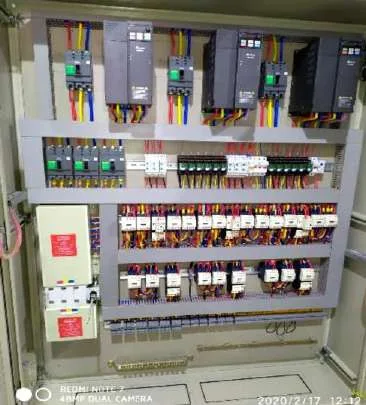
An AHU or FAHU control panel powers and controls the unit's fans, valves and dampers, runs the control loops that hold temperature, humidity and airflow, and connects the unit to the fire alarm and the building management system. In the UAE, the fresh air unit has the hardest job, because it takes in hot, humid outside air. Al Qudrah Switchgear in Sharjah, UAE builds control panels for FAHUs and AHUs, and this article sets out what a good one contains.
AHU and FAHU: what is the difference?
An AHU (air handling unit) mostly recirculates and conditions air from the space it serves, with some fresh air mixed in. A FAHU (fresh air handling unit) conditions 100% outside air before supplying it to the building or to other AHUs and fan coil units.
That difference drives the controls. An AHU's main task is holding supply or space temperature. A FAHU in a Gulf summer has to remove a large amount of moisture from outside air that can be hot and very humid, often with a heat recovery wheel or plate exchanger using the exhaust air to pre-cool the incoming air. Dehumidification, heavy condensate loads on the coil and heat recovery control make FAHU panels more involved than standard AHU panels.
What is inside the panel?
The panel combines a power section for the motors and a control section with a DDC controller or PLC. On most modern units the fans run on variable frequency drives.
- Incoming isolator and protection, sized for the total fan and accessory load.
- VFDs for supply and return or exhaust fans, with bypass where the specification requires it.
- Motor protection for the heat recovery wheel drive, if fitted.
- A controller with I/O for sensors, valve and damper actuators, and alarms.
- 24 V AC or DC supplies for actuators and sensors, with separate protection.
- Fire alarm interface relays and hardwired shutdown circuits.
- Hand-off-auto selectors and indication on the door for each fan.
- A communication interface to the BMS.
For units mounted on the roof, the panel enclosure and its cooling deserve their own attention, which we cover below.
The control loops that matter
Most AHU and FAHU control comes down to a few loops: supply air temperature, humidity, airflow or duct pressure, and, on many buildings, CO₂-based fresh air control. Each loop needs the right sensor in the right place.
| Loop | Measured | Controlled device |
|---|---|---|
| Supply air temperature | Supply duct temperature sensor | Chilled water valve |
| Dehumidification (FAHU) | Off-coil temperature or supply humidity | Chilled water valve, sometimes reheat |
| Duct static pressure or airflow | Pressure transmitter or airflow station | Supply fan VFD |
| Return or exhaust pressure balance | Pressure or flow | Return / exhaust fan VFD |
| Demand-controlled ventilation | CO₂ in return air or space | Fresh air damper or FAHU fan speed |
| Heat recovery | Outside, exhaust and supply temperatures | Wheel speed or bypass damper |
Filter differential pressure switches, fan status from the VFD or a pressure switch, and freeze or condensate alarms complete the picture. Sensor location is the commonest site problem: a supply temperature sensor placed too close to the coil reads stratified air and makes the valve hunt.
Fire alarm and life safety interface
The fire alarm interface decides what the unit does in a fire: shut down, or run in a smoke control mode. That decision comes from the building's fire and life safety strategy, approved by civil defence, not from the panel builder.
Most specifications require the fire shutdown to be hardwired, so it works even if the controller or VFD fails, and to override the BMS and hand-off-auto selectors. Where a unit forms part of a smoke management system, the panel must follow the approved cause-and-effect matrix, which may require specific fans to run, dampers to move to fixed positions, and VFDs to run at set speeds. We wire and test these circuits against the cause-and-effect matrix before dispatch.
BMS integration
The BMS monitors and usually sets the operating schedule and set points; the local controller runs the loops. The integration method, Modbus, BACnet or hardwired, and the point list must be agreed with the BMS contractor early.
Typical BMS points per unit are run command and status, fault and trip alarms, filter alarms, supply and return temperatures, humidity, set points, valve and damper positions, VFD speed and, where available, VFD power and energy. Reading VFD data over Modbus gives far more information than hardwired signals, for less wiring. Our article on DDC panels and BMS integration covers this in more depth.
Keeping the panel cool
Heat is the main reliability risk for AHU panels in the UAE. VFDs dissipate a few percent of their rated power as heat inside the panel, and roof-mounted panels also absorb direct sun.
The heat load of every panel should be calculated from the drive and power supply losses plus solar gain where relevant, and then used to choose between filtered fan ventilation and a panel air conditioner. For outdoor panels in direct sun we recommend a canopy or sunshade, light-coloured enclosures, and a drive layout that keeps the hottest components away from the controller. A VFD derated for the real temperature inside the panel will outlast one sized to its nameplate. Our VFD and control panel range is on the DDC and BMS section of our solutions page.
Frequently asked questions
Why do FAHU panels need dehumidification control?
A FAHU takes in 100% outside air, which in UAE summers is hot and often very humid. If the unit only controls temperature, moist air reaches the building and causes condensation, mould and discomfort. FAHU controls usually drive the chilled water coil to a low off-coil temperature to condense moisture out, sometimes with reheat or heat recovery to bring the supply temperature back up.
Should the fire alarm shutdown be hardwired or through the BMS?
Most specifications require a hardwired fire alarm shutdown or smoke mode command, so the unit responds even if the controller, network or VFD fails. The BMS can monitor the fire status, but it should not be the only path. The required action for each unit comes from the approved fire and life safety strategy and its cause-and-effect matrix.
Do AHU panels need air conditioning?
It depends on the heat load and the location. Panels in a cooled plant room may only need filtered ventilation. Panels on the roof with several VFDs often need a panel air conditioner, because the outside air is too hot to cool the components. We calculate the heat load for each panel and select cooling to keep drives within their rated temperature.
What BMS points does a typical AHU panel provide?
Typical points include run command and status, trip and fault alarms, filter alarms, supply and return air temperatures, humidity, set points, valve and damper positions, and VFD speed. With a Modbus or BACnet link to the VFDs and controller, the BMS can also read motor current, power and energy for each fan.