
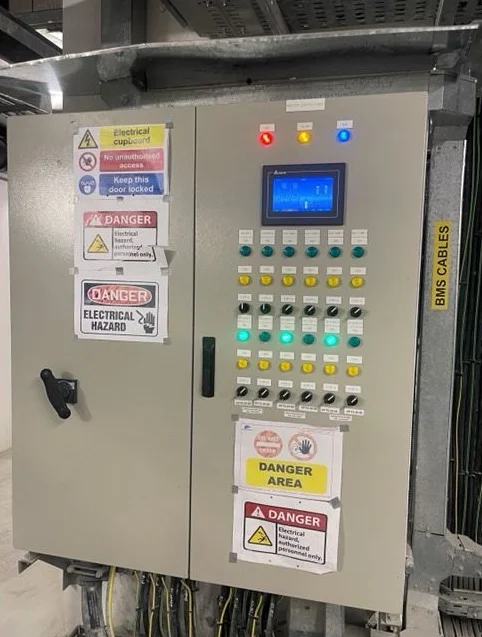
A DDC (direct digital control) panel is the local controller that runs a piece of building plant and reports it to the building management system (BMS). Integration works when both sides agree, before anyone programs anything, on the point list, the protocol and who controls what. Al Qudrah Switchgear in Sharjah, UAE built the heat pump master control panel for Vida Dubai Mall, with a PLC, an HMI and BMS points, and this article shares the practices we apply on plant-room panels like that one.
What does a DDC panel do?
A DDC panel reads sensors, runs control logic and drives actuators for one system, such as an AHU, a chilled water plant or a heat pump plant. It keeps working on its own if the BMS network goes down, and it exposes data and selected commands to the BMS.
The panel normally holds a programmable controller (a DDC controller or a PLC, depending on the job), I/O modules, power supplies, interface relays, and terminals for field wiring. Many also include motor starters or VFDs for the plant they control. The key design principle is that control lives locally. The BMS supervises, schedules and records; it should not be needed to keep the plant safe.
The Vida Dubai Mall heat pump master panel
For the heat pump plant at Vida Dubai Mall, we built a master control panel combining PLC control, a local HMI for operators, and BMS points for the building's central system. It is the kind of job where local control and BMS integration have to be designed together.
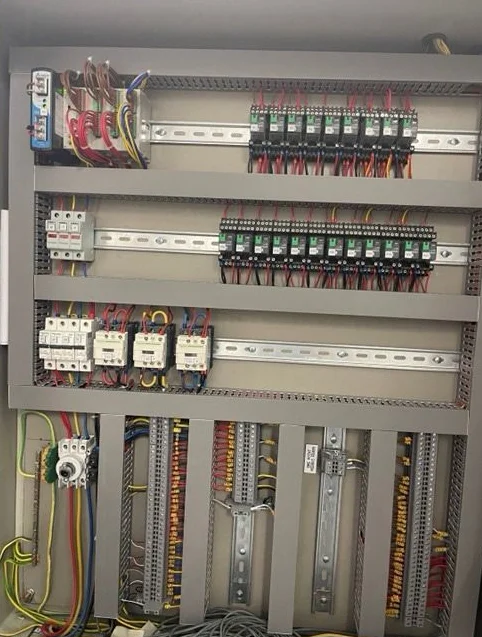
A master panel of this type coordinates several machines as one plant: it decides which units run, in what order, and at what set point, while each machine keeps its own internal protection. The HMI lets the plant operator see and run the system locally, and the BMS sees the plant's status, alarms and key values. The lessons below are the ones we apply on this kind of panel.
Lesson 1: agree the point list before programming
A point list agreed and signed by the panel builder, the BMS contractor and the consultant prevents most integration problems. Each point needs a name, type, address, data format, units, scaling and read or write access.
"Supply temperature" is not enough. The BMS contractor needs to know it is holding register 40012, a signed 16-bit integer in tenths of a degree Celsius, read only. Without that level of detail, two systems that both "support Modbus" will exchange numbers that mean nothing to each other. The point list belongs in the submittal and should be updated with each revision.
| Field | Example |
|---|---|
| Point name | HP-01 leaving water temperature |
| Type | Analogue value, read only |
| Protocol and address | Modbus TCP, holding register (agreed number) |
| Data format and scaling | Signed 16-bit, value ÷ 10 = °C |
| Alarm limits | Set in PLC or BMS, agreed in advance |
Lesson 2: decide who is in control
For every command, decide whether the local controller or the BMS has the final say, and what happens when the link fails. Two systems both trying to control the same plant will fight.
A workable split: the BMS can enable or disable the plant, change schedules and adjust set points within limits set in the PLC. Sequencing, staging and protection stay in the local controller. If BMS communication is lost, the plant continues on its last valid set point or a safe default, and raises an alarm. Hand-off-auto selectors and the local HMI always take priority over remote commands, so a technician on site is never overridden from a control room.
Lesson 3: choose the protocol and test it early
Modbus RTU, Modbus TCP and BACnet are the common protocols in UAE buildings. The BMS specification normally decides which one is used; the important step is proving the link early.
BACnet carries more structure (objects, units, alarms) and suits large BMS installations. Modbus is simpler and supported by almost every drive, meter and controller. Whichever is used, test the communication at the factory with a simulator or, when possible, with the BMS contractor's own laptop and software during the factory acceptance test. Finding a byte-order mismatch in Sharjah is far cheaper than finding it in a plant room during handover week.
Lesson 4: design the panel for the plant room
Plant rooms are hot, sometimes humid, and often crowded. The panel's IP rating, cooling and cable entry need to suit the room, not just the drawing.
Calculate the heat load from controllers, power supplies and any drives, and choose ventilation or air conditioning to match. Signal cables and communication cables are segregated from power wiring inside the panel, network devices get surge protection, and the PLC sits on a UPS so it rides through supply dips and records why the plant stopped. Clear labelling of every terminal and network port saves time years later.
Integration checklist
- Signed point list with addresses, data types and scaling.
- Control authority defined for every command, with loss-of-communication behaviour.
- Protocol, network addresses, baud rates or IP settings agreed in writing.
- Factory test of communication with a simulator or the BMS contractor's tools.
- Local HMI and hand-off-auto selectors with priority over remote commands.
- As-built point list and program handed over with the panel documentation.
For the wider process of PLC panel projects, see PLC and SCADA control panels. Our DDC and BMS panels are described on the DDC and BMS page, and the Vida project is on our projects page.
Frequently asked questions
What is the difference between a DDC panel and a BMS?
A DDC panel is a local controller that runs a specific system, such as an AHU or a heat pump plant, and keeps it running even if the network fails. The BMS is the central supervisory system that monitors many DDC panels, sets schedules and set points, records trends and handles alarms for the whole building. The DDC panel controls; the BMS supervises.
Which is better for BMS integration, Modbus or BACnet?
Neither is better in every case. BACnet carries richer information such as units, object types and alarms, and suits large BMS systems. Modbus is simpler and supported by nearly every drive, meter and controller. The BMS specification usually decides. What matters most is a detailed, agreed point list and early testing of the link.
What should happen if the BMS link fails?
The plant should keep running safely under local control. Typically, the DDC or PLC continues on the last valid set point or a pre-set safe default, keeps all sequencing and protection active, and raises a communication alarm locally and on the BMS when the link returns. The plant should never depend on the BMS to stay safe.
What did Al Qudrah supply for Vida Dubai Mall?
Al Qudrah built the heat pump master control panel for Vida Dubai Mall. It combines PLC control of the heat pump plant, a local HMI for operators, and BMS points so the building's central management system can monitor the plant. Like every panel we ship, it was built and tested at our factory in Sharjah.