
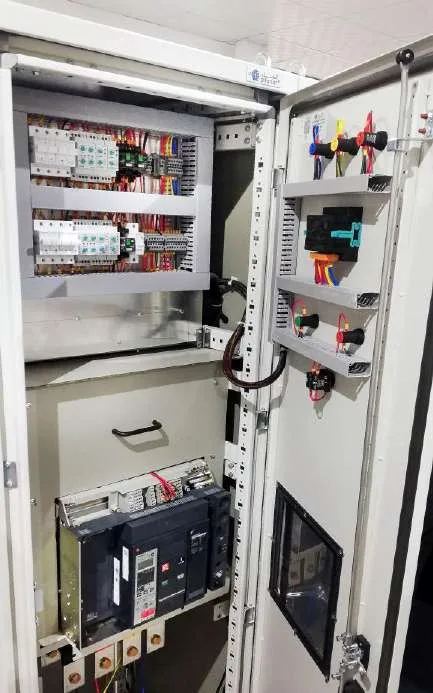
An automatic transfer switch (ATS) panel watches the mains supply, starts the standby generator when the mains fails, transfers the load once the generator is ready, and transfers it back when the mains returns and stays stable. The whole sequence is controlled by timers and protected by interlocks so the two sources are never connected together. Al Qudrah Switchgear in Sharjah, UAE builds ATS panels for hospitals, civil defence stations, towers and restaurants, and this is how we explain the design to consultants.
The transfer sequence, step by step
A standard open-transition ATS breaks the mains connection before making the generator connection, with a short dead time in between. The controller runs this sequence automatically:
- The controller detects a mains problem: undervoltage, overvoltage, phase loss, wrong phase sequence or frequency out of range.
- A short confirmation delay (often a few seconds) rides through brief dips so the generator is not started for every flicker.
- The controller sends a start signal to the generator.
- Once generator voltage and frequency are within limits, and any warm-up delay has passed, the mains breaker opens.
- After a short dead time, the generator breaker closes and the load is on standby power.
- When the mains returns, a return delay (often several minutes) checks that it is stable before transferring back.
- The load is transferred back to mains, and the generator runs unloaded for a cool-down period before stopping.
Every timer is adjustable. The consultant usually specifies them, and the values are confirmed at commissioning with the generator supplier.
What switching devices does an ATS use?
An ATS uses either two interlocked motorised breakers (ACBs or MCCBs) with a controller, or a purpose-built transfer switch. Either way, the equipment should meet IEC 60947-6-1, the standard for transfer switching equipment, or be a verified arrangement of IEC 60947-2 breakers.
Motorised breakers give overcurrent protection on each source and suit higher ratings, typically as part of an MDB or emergency board. Purpose-built transfer switches are compact and fast, and suit smaller ratings. Both work well when chosen correctly; the choice depends on rating, space, fault level and whether protection is needed at the ATS itself.
Interlocking: never parallel the two sources
An open-transition ATS must make it physically and electrically impossible to close the mains and generator breakers at the same time. That is achieved with at least two independent interlocks.
- Mechanical interlock between the two breakers, so one cannot close while the other is closed, even by hand.
- Electrical interlock in the closing circuits, using auxiliary contacts of each breaker.
- Controller logic as a third layer, never as the only one.
Paralleling a private generator with the utility network, even briefly, needs the utility's approval and additional protection. Closed-transition schemes exist but are a separate design decision. Without explicit approval from the authority, assume open transition.
3-pole or 4-pole switching?
Whether the ATS switches the neutral depends on the earthing arrangement of the installation and of the generator, and on the authority's rules. The consultant decides; the panel builder builds to that decision.
The usual reasoning: if the generator neutral is earthed separately at the generator, a 4-pole ATS keeps the two neutral-earth points apart and avoids circulating neutral currents that confuse earth-fault protection. Where the neutral is earthed only once, at the main earthing point, a 3-pole ATS with a solid neutral may be acceptable. Getting this wrong causes earth-leakage relays to trip for no apparent reason after commissioning, so it is worth settling on the single-line diagram, not on site.
What to specify for an ATS panel
Give the panel builder the information in the table below and you will get a panel that matches the generator and the load from the first submittal.
| Item | Why it matters |
|---|---|
| Rated current and fault level at the ATS | Sets the breaker or switch rating and short-circuit withstand |
| Number of poles | Depends on earthing arrangement; affects earth-fault protection |
| Sensing: voltage, frequency, phase loss, phase sequence | Defines what counts as a mains failure |
| Timer ranges | Confirmation, transfer, return and cool-down delays |
| Generator interface | Start/stop signal, generator ready, alarms, test mode |
| Load shedding | Which loads are dropped when the generator is smaller than the full load |
| Indication and BMS | Source available, breaker positions, alarms, Modbus or volt-free contacts |
| Manual operation | Manual mode and bypass for maintenance |
For life-safety loads, the specification and the civil defence requirements also govern which loads sit on the emergency board and how quickly they must be restored. These differ by emirate and by building type.
Where the site has more than one generator, an ATS on its own is not enough. Generators must be synchronised before they can share load, which we cover in generator synchronising panels.
Testing an ATS before handover
Test the full sequence with the real generator, not just the controller on the bench. Factory tests prove the wiring and logic; site tests prove the timing with the actual engine.
At our factory we check interlocks, the sequence and every timer by simulating mains failure and return, along with insulation resistance at 1000 V DC and a 2.5 kV dielectric test, before issuing the signed test certificate. On site, the commissioning team pulls the mains supply, measures the actual transfer time and confirms that load shedding and alarms work. More on our product range is on the ATS panels page, and our projects include Dubai Civil Defence stations and hospitals on the projects page.
Frequently asked questions
How long does an ATS take to transfer to the generator?
It depends on the timers and on how fast the generator starts. The ATS switching itself takes well under a second, but the total includes the mains-failure confirmation delay and the generator's start and run-up time. The consultant sets the requirement, which for life-safety loads is often defined by civil defence or the specification.
Should an ATS be 3-pole or 4-pole?
It depends on how the installation and the generator are earthed. Where the generator neutral is separately earthed, a 4-pole ATS is normally used so the neutral is switched with the phases and earth-fault protection works correctly. Where there is a single neutral-earth point, 3-pole may be acceptable. The consultant and the authority decide.
Can an ATS run the generator in parallel with the mains?
A standard open-transition ATS cannot, because it is interlocked to prevent it. Closed-transition transfer briefly parallels the two sources and needs the utility's approval and additional protection such as reverse power and synchronising checks. Without explicit utility approval, specify open transition with mechanical and electrical interlocking.
What is the difference between an ATS and a manual changeover panel?
A manual changeover panel needs an operator to switch between mains and generator using a changeover switch or interlocked breakers. An ATS detects the failure, starts the generator and transfers the load by itself. Manual changeover suits small or non-critical loads; ATS is the norm for life-safety and continuous-operation loads.