
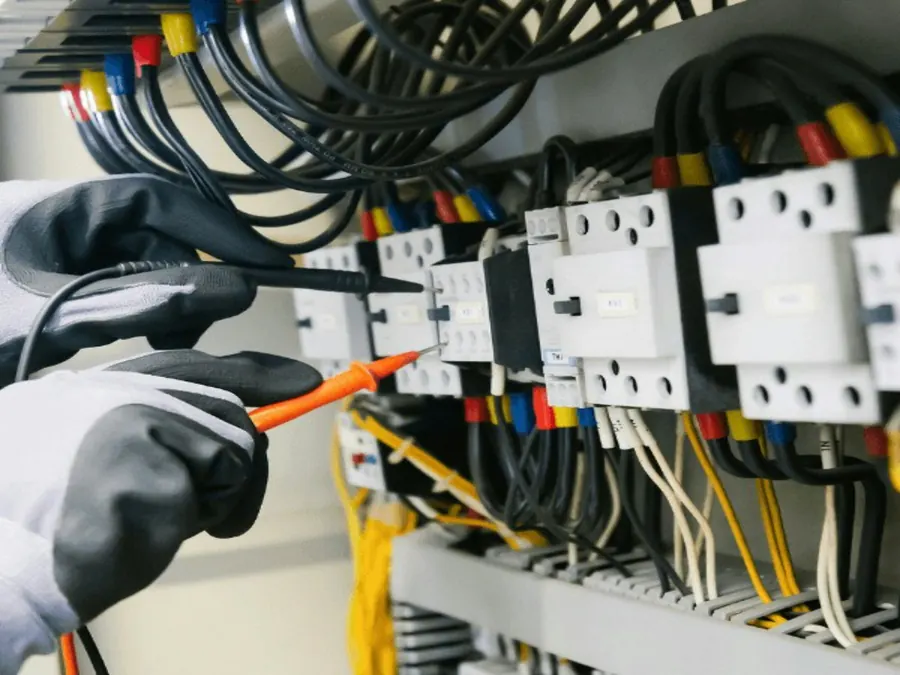
A generator synchronising panel lets two or more generators run in parallel on a common busbar by matching each incoming set's voltage, frequency and phase angle to the bus before closing its breaker, then sharing the load between them. It gives a site more capacity and redundancy than a single large generator. Al Qudrah Switchgear in Sharjah, UAE builds generator auto-synchronising panels, and this article covers how they work and what a specification needs to say.
Why run generators in parallel?
Paralleling gives redundancy, flexibility and better fuel use. If one set fails or is down for maintenance, the others carry the critical load, and at light load the controller can run fewer sets closer to their efficient loading.
Typical sites are hospitals, data rooms, large hotels, industrial plants and remote sites with no grid supply. Two 1000 kVA sets in parallel can supply the same peak as one 2000 kVA set, but they keep half the capacity available if one stops, and they avoid running a single large engine at 20% load through the night, which is hard on diesel engines.
How does synchronising work?
Before an incoming generator's breaker can close onto a live bus, three things must match within tight limits: voltage magnitude, frequency, and phase angle. The synchroniser adjusts the engine governor and the alternator's voltage regulator until they do, then closes the breaker at the right instant.
- Voltage is matched through the automatic voltage regulator (AVR).
- Frequency is matched through the engine governor, with the incoming set running very slightly fast so it picks up load gently when it closes.
- Phase angle is checked continuously, and the close command is timed to allow for the breaker's closing time.
- A check-synchronising relay acts as an independent permissive, so a controller fault cannot close the breaker out of phase.
Closing out of phase produces very high currents and mechanical shock on the engine, alternator and busbars. That is why the check-sync function should be independent of the main controller.
The first generator to start closes onto a dead bus. The controllers must coordinate so only one set does this; dead-bus arbitration is a standard function in modern paralleling controllers.
Load sharing: kW and kVAr
Once in parallel, the generators must share both real power (kW) and reactive power (kVAr) in proportion to their ratings. Real power is shared through the governors, reactive power through the AVRs.
Modern controllers share load digitally over a communication link between the sets. Older schemes used analogue load-sharing lines or droop. Whichever method is used, unbalanced sharing shows up quickly: one set carries more kW and runs hotter, or circulating reactive current flows between alternators and trips them on overcurrent. Load sharing has to be tuned at commissioning with the engines running under real load, ideally with a load bank.
Load-demand control and load shedding
Load-demand control starts and stops sets automatically as the load changes. Load shedding drops non-essential loads if the running sets cannot carry everything.
A typical scheme for a three-set plant works like this:
- On mains failure, all sets start. The first ready set closes onto the dead bus and the others synchronise to it.
- Loads are connected in priority order, with life-safety loads first.
- When load falls below a set threshold for a set time, the controller ramps one set down, opens its breaker and lets it cool down before stopping.
- If load rises again, a standby set starts, synchronises and ramps up.
- If a set trips, non-essential feeders are shed at once so the remaining sets are not overloaded.
- Running hours are balanced by rotating the duty order.
Protection and panel contents
Each generator incomer needs protection for faults that only appear in parallel operation, in addition to the usual overcurrent and earth-fault protection. Reverse power protection is the one that is easiest to forget and most important.
| Function | Purpose |
|---|---|
| Reverse power | Trips a set that starts motoring, for example after a fuel problem |
| Over/under voltage and frequency | Protects the load and the bus |
| Overcurrent and earth fault | Standard feeder protection, coordinated with downstream breakers |
| Loss of excitation / reactive power limits | Prevents one alternator absorbing reactive power from the others |
| Check synchronising | Independent permissive for breaker closing |
A typical panel has one motorised ACB per generator, a common busbar sized for the total plant, the synchronising and load-sharing controllers, metering per set, an HMI or controller displays, and outgoing feeders or a tie to the main LV board. Communication to the BMS is usually Modbus.
Paralleling the generator plant with the utility supply, for example for peak lopping or no-break transfer back to mains, is a separate case. It requires the utility's approval and additional protection at the point of connection, and the rules differ between UAE authorities. For a single generator with no paralleling, an ATS panel is enough; see ATS panels for mains-generator changeover.
Specifying a synchronising panel
The panel builder needs the generator data, the operating philosophy and the interface list. With those, the controller can be selected and the panel designed in one pass.
- Number, rating and make of generators, and the governor and AVR types.
- Bus rating and fault level with all sets running.
- Whether mains paralleling is required, and if so the utility's approval.
- Load priorities and the load-shedding list.
- Neutral earthing arrangement for the plant.
- BMS points and protocol.
Our power distribution range, including generator panels, is on the solutions page. Factory function tests simulate the sequence before dispatch; final load-sharing tuning is always done on site with the engines running.
Frequently asked questions
Can generators of different sizes run in parallel?
Yes. The controllers share load in proportion to each set's rating, so a 500 kVA and a 1000 kVA set can run together with each carrying the same percentage of its capacity. The engines and alternators must have compatible governors and voltage regulators, and the load-sharing settings must be tuned at commissioning under real load.
What happens if one generator fails while in parallel?
Its protection opens its breaker, and the remaining sets pick up its share of the load. If the remaining capacity is not enough, the controller sheds non-essential loads immediately so the running sets are not overloaded. A standby set, if available, starts, synchronises and closes onto the bus, and shed loads can then be restored in priority order.
Do I need utility approval for a generator synchronising panel?
Not if the generators only parallel with each other and an interlocked ATS keeps them separate from the mains. If the generators will parallel with the utility network, even briefly for a no-break transfer, the utility's approval is required along with additional protection at the point of connection. Requirements vary between UAE authorities.
Why is reverse power protection important?
If a generator loses fuel or its governor fails while in parallel, the other sets drive it as a motor, drawing power from the bus. This can damage the engine and overloads the remaining sets. Reverse power protection detects power flowing into the generator and trips its breaker within seconds.