
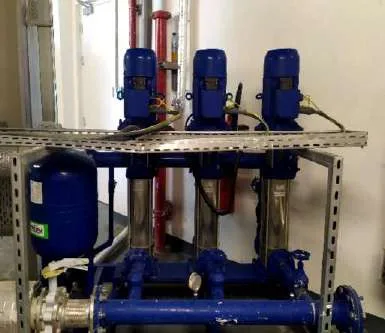
A booster pump control panel keeps water pressure constant at the outlet of a pump set, whatever the demand, by changing pump speed with variable frequency drives and bringing pumps in and out as flow rises and falls. It also protects the pumps against running dry, over-pressure and overheating. Al Qudrah Switchgear in Sharjah, UAE builds booster pump panels for towers, villa communities and plant rooms, and this is how they work.
How constant-pressure control works
A pressure transmitter on the discharge header measures system pressure, and a PID controller adjusts the speed of the duty pump's VFD to hold it at the set point. When demand rises, the pump speeds up; when it falls, the pump slows down.
When one pump at full speed can no longer hold pressure, the controller starts a second pump and both share the flow. As demand drops again, the second pump stops after a delay, so pumps don't cycle on and off with every tap. At very low demand, typically overnight, a sleep function stops the last pump once pressure is up and restarts it when pressure falls below a wake-up threshold.
Compared with fixed-speed pumps controlled by pressure switches, this gives steadier pressure at the outlets, far fewer starts, less water hammer and lower energy use, because pump power falls steeply with speed.
Common pump arrangements
The arrangement depends on the building's demand profile and how much redundancy the consultant wants. Duty-standby suits small systems; duty-assist-standby and multi-pump sets suit towers and large communities.
| Arrangement | How it runs | Typical use |
|---|---|---|
| Duty / standby | One pump runs, the other takes over on failure; duty alternates | Villas, small buildings |
| Duty / assist / standby | One pump runs, a second assists at high demand, a third is spare | Mid-rise buildings, compounds |
| Multi-pump (4 or 5 pumps) | Pumps staged in and out with demand, one or more standby | High-rise towers, large communities |
The panel can use one VFD per pump, which gives the smoothest control and redundancy if a drive fails, or one VFD switched between pumps with the rest on fixed-speed starters, which costs less but is less flexible. For most new towers and communities, one drive per pump is the better choice.
Protection the panel must provide
Dry running is the fastest way to destroy a pump, so low-level protection from the suction tank is the first priority. The rest protects the pumps, the pipework and the motors.
- Low water level in the tank, from float switches or a level transmitter, stops all pumps and raises an alarm. Pumps restart automatically when the level recovers.
- High discharge pressure, from a separate pressure switch, trips the pumps if the transmitter or controller fails.
- Pressure transmitter failure is detected by the controller, which can switch to a safe fallback mode.
- Motor overload, phase loss and thermistor protection come from the VFDs and motor protection devices.
- A pipe-fill mode ramps pressure up slowly after a shutdown, so air is purged and the risers are not hit with a pressure surge.
- Pump rotation by running hours spreads wear evenly, and the standby pump takes over automatically if a duty pump trips.
Towers versus villas
In high-rise buildings, booster panels usually feed several pressure zones, and the controls must cope with large flow variations through the day. In villas and townhouses, systems are small but numerous, so simplicity and repeatability matter most.
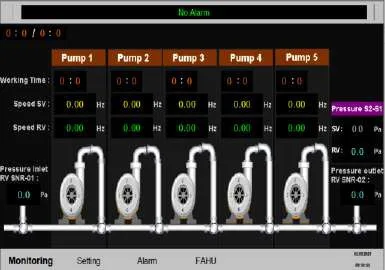
In a tower, the plumbing designer splits the building into zones so that pressure at the lowest outlets in each zone stays within limits. That may mean separate pump sets per zone, or one set with pressure-reducing valves. Each set gets its own panel or section, often with a touch-screen HMI showing every pump, the header pressure and the alarm history.
In a villa community, the same small panel may be built hundreds of times. A standard, tested design with clear labelling and simple controls is worth more than extra features. Our experience with large communities is described in supplying switchgear for villa communities.
BMS signals and commissioning
Most booster panels report to the building management system over Modbus or hardwired contacts. Commissioning then proves the sequence with real water, not just simulated signals.
Typical BMS points are pump run status and faults, system pressure, tank level alarms, common alarm, and the active duty pump. With a Modbus link the BMS can also read pump speed, current and running hours.
At commissioning, we set the pressure set point with the plumbing designer, tune the PID loop with real demand, check the staging thresholds and delays, and test each protection: drain the tank to trip the low-level, close a valve to test high pressure, and disconnect the transmitter to check the fallback. Before dispatch, each panel passes our routine factory tests, including insulation resistance at 1000 V DC and function tests, with a signed certificate. Booster panels are part of our control panel range listed on the solutions page.
Frequently asked questions
Why use VFDs on booster pumps instead of pressure switches?
VFDs hold the pressure steady by adjusting pump speed to demand, while pressure switch control starts and stops fixed-speed pumps between two pressure limits. VFD control gives steadier pressure at the outlets, fewer pump starts, less water hammer and lower energy use, especially in buildings where demand varies widely through the day.
What protects a booster pump from running dry?
A low-level signal from the suction tank, from float switches or a level transmitter, stops all pumps and raises an alarm before the water drops below the pump suction. When the level recovers, the panel restarts the pumps automatically. Some designs also monitor pump power or flow as a second check for dry running.
How often should duty pumps rotate?
Most panels rotate the duty pump based on running hours or at a fixed time each day, so all pumps wear evenly and the standby pump is exercised regularly. The rotation interval is a setting, agreed with the facility team. A pump that sits idle for months can seize, so regular rotation also protects the standby.
Can a booster panel send alarms to the BMS?
Yes. Booster panels usually provide pump status, trip alarms, system pressure, tank level alarms and a common alarm to the BMS, either as hardwired volt-free contacts or over Modbus. A Modbus link also lets the BMS read pump speed, current and running hours for maintenance planning.