
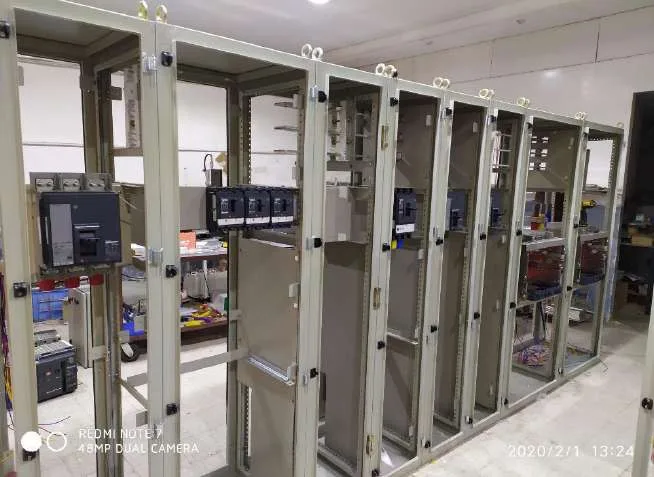
Routine verification under IEC 61439 is the set of checks every individual LV assembly must pass before it leaves the factory, to prove it was built correctly to its verified design. It covers construction (enclosure, clearances, protective circuit, wiring, components) and performance (dielectric properties, mechanical operation and function). At Al Qudrah Switchgear in Sharjah, UAE, every panel goes through these tests and leaves with a signed factory test certificate, and consultants and contractors are welcome to witness them.
What does IEC 61439 routine verification include?
IEC 61439-1 lists the routine verification items. They fall into two groups: checks on how the assembly is built, and tests on how it performs.
| Group | Item | What is checked |
|---|---|---|
| Construction | Degree of protection | Enclosure, doors, covers and gland plates match the specified IP |
| Construction | Clearances and creepage distances | Spacing between live parts and to earth |
| Construction | Protection against electric shock | Barriers, shrouds and continuity of the protective circuit |
| Construction | Built-in components | Correct devices, ratings and installation to the drawings |
| Construction | Internal circuits and connections | Wiring, busbar joints and tightness of connections |
| Construction | Terminals for external conductors | Number, type and size suit the incoming cables |
| Construction | Mechanical operation | Doors, interlocks, withdrawable parts and operating mechanisms |
| Performance | Dielectric properties | Power-frequency withstand test, or insulation measurement where the standard allows |
| Performance | Wiring, operational performance and function | Control, interlock, metering and protection circuits work as designed |
Routine verification is not a substitute for design verification, which is done once on the design. We explain the difference in IEC 61439-2 design verification.
Our routine tests on every panel
Every Al Qudrah panel gets visual and mechanical inspection with torque marking, insulation resistance at 1000 V DC, a dielectric (flash) test at 2.5 kV for one minute, and function tests. The results go on a signed factory test certificate for that board.
- Visual and mechanical inspection: devices and ratings against the approved drawings and bill of materials, labelling, barriers and shrouds, door and interlock operation, IP features such as gaskets and gland plates.
- Torque check and marking: busbar and power connections are tightened to the specified torque with calibrated tools, then marked so any later loosening is visible.
- Insulation resistance at 1000 V DC between phases and from each phase to earth.
- Dielectric test at 2.5 kV for one minute between live parts and earth, with no breakdown or flashover.
- Protective circuit continuity from exposed conductive parts to the main earth bar.
- Function tests: control circuits, interlocks, ATS sequences, metering and indication, using secondary or primary injection where protection settings need proving.
Electronic devices that cannot withstand the test voltage, such as meters, surge protective devices and some controllers, are disconnected for the dielectric test and reconnected afterwards. The test record should say which ones.
The instruments behind the results
A test result is only as reliable as the instrument that produced it. We use 11 calibrated instruments, calibrated by EIAC-accredited laboratories working to ISO/IEC 17025.
They include HIOKI insulation testers, a 2.5/5 kV high-voltage test set, a primary injection set up to 3000 A, a secondary injection set for relay and trip unit testing, a 150 A millivolt-drop tester for joint and contact resistance, a CT polarity tester, an RCD tester and calibrated torque tools. When you witness a test, ask to see the calibration certificate for the instrument in use. Our calibration records are summarised on the testing section of our certificates page.
How to witness a factory acceptance test
A witnessed FAT is the last chance to find problems while the panel is still in the factory, where fixing them is quick. Prepare for it and you will get far more out of the visit.
- Agree the test procedure and acceptance criteria in advance, as part of the inspection and test plan in the submittal.
- Bring the approved drawings, with the latest revision marked, and check the panel against them, not against the factory's copy.
- Start with the visual check: nameplates, device ratings, breaker settings, labelling, barriers, gland plates and earth bar.
- Watch the insulation resistance and dielectric tests and record the values, not just "pass".
- Ask for function tests of the circuits that matter: ATS sequences, interlocks, meters, alarms and any BMS interface.
- Open a few compartments at random and check torque marks and wiring quality.
- Record any punch items with a clear close-out action before signing the certificate.
Allow enough time. A line-up of several MDB sections with control circuits can take most of a day to witness properly.
Common findings at a FAT
Most FAT findings are small and quick to fix in the factory: labels that don't match the latest drawing revision, a breaker setting left at default, a missing shroud, or a wire number out of sequence.
Larger findings usually trace back to late design changes that did not reach the workshop, which is why revision control on drawings matters so much. A FAT that finds nothing is not a reason to skip the next one; it is a sign the process upstream worked. After dispatch, site testing and commissioning confirm the installation, cabling and settings; our commissioning service covers that stage.
Frequently asked questions
What is the difference between routine verification and a FAT?
Routine verification is the set of checks IEC 61439 requires on every assembly before dispatch. A factory acceptance test (FAT) is the client's or consultant's inspection of those checks, often with extra function tests agreed in the inspection and test plan. In practice the FAT is the witnessed version of routine verification, plus anything the project specification adds.
What test voltage does Al Qudrah use for the dielectric test?
We apply 2.5 kV for one minute between live parts and earth, with no breakdown or flashover allowed. Insulation resistance is measured separately at 1000 V DC. Electronic devices that cannot withstand the test voltage are disconnected for the test and reconnected afterwards, and the record states which devices were isolated.
Why are busbar connections torque-marked?
After each bolted connection is tightened to the specified torque with a calibrated tool, a paint mark is drawn across the bolt head and the busbar. If the bolt later turns or loosens during transport or installation, the mark breaks, which makes the problem visible during inspection. It is a simple, reliable record that every joint was checked.
Can consultants witness tests at Al Qudrah's factory?
Yes. Consultants and contractors can witness routine tests at our factory in Emirates Industrial City (Al Sajaa), Sharjah. We agree the procedure and date in advance, provide calibrated instruments with their certificates, and issue a signed factory test certificate for each panel. Contact us to schedule a witness visit.