
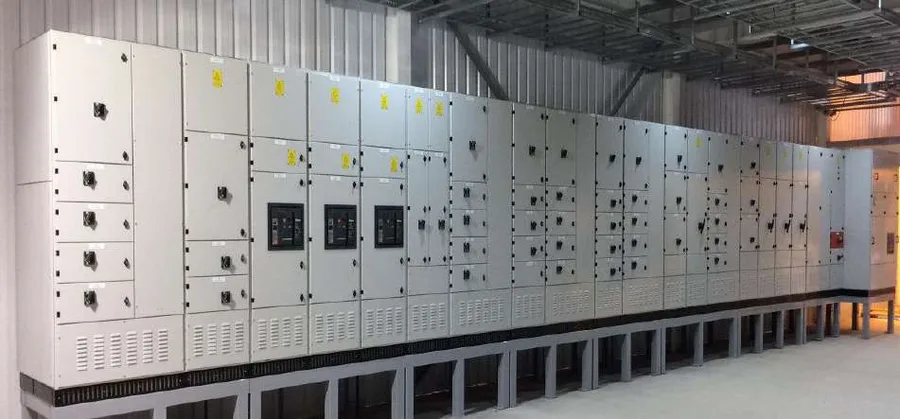
A form of separation describes how a low-voltage switchboard is divided inside: which parts are walled off from the busbars, and which are walled off from each other. IEC 61439-2 defines Forms 1, 2a, 2b, 3a, 3b, 4a and 4b, and the right choice depends on how much of the board you need to keep live while someone works on one circuit. At Al Qudrah Switchgear in Sharjah, UAE, we build Forms 2a to 4b every week, and this is how we explain them to consultants and contractors.
What does "form of separation" mean?
It is the level of internal partitioning between three things: the busbars, the functional units (the breakers or starters), and the terminals where outgoing cables connect. Each step up the scale adds barriers, so a fault or a maintenance job in one area is less likely to reach another.
The barriers can be metal or insulating sheets, or the insulation of live parts themselves. Separation is there to protect against contact with live parts in neighbouring units and to stop foreign objects from moving between compartments. It is not an arc-containment rating, and a Form 4 board is not automatically arc-resistant. If the specification needs internal arc performance, that is a separate requirement and a separate test.
IEC 61439-2 leaves the form to agreement between the user and the assembly manufacturer. In practice the consultant writes it into the specification, and we design the board to match.
Form 1 to Form 4b: what each one gives you
Form 1 has no internal separation, Form 2 separates busbars from functional units, Form 3 also separates the functional units from each other, and Form 4 also separates each unit's outgoing terminals from the others. The letters "a" and "b" say whether the cable terminals are separated from the busbars (Forms 2 and 3) or how the terminals sit relative to their own unit (Form 4).
| Form | Busbars separated from units | Units separated from each other | Terminals arrangement |
|---|---|---|---|
| 1 | No | No | No separation |
| 2a | Yes | No | Terminals not separated from busbars |
| 2b | Yes | No | Terminals separated from busbars |
| 3a | Yes | Yes | Terminals not separated from busbars |
| 3b | Yes | Yes | Terminals separated from busbars, shared between units |
| 4a | Yes | Yes | Each unit's terminals in the same compartment as that unit |
| 4b | Yes | Yes | Each unit's terminals in their own compartment, apart from the unit |
Form 4b is the most partitioned arrangement. An electrician can terminate or re-terminate a cable for one feeder without opening the compartment of the breaker that feeds it, and without being exposed to the busbars or other feeders' terminals.
How do you choose the right form?
Choose the form by asking what must stay energised during maintenance and how often circuits will be changed. A small DB feeding a single tenant rarely needs more than Form 1 or 2; a main distribution board for a hospital or a data room usually justifies Form 3b or 4b.
The questions we ask on a new enquiry are simple:
- Will the client accept a full shutdown to work on one outgoing circuit? If not, Form 3 or 4 is the minimum.
- Are cable alterations expected after handover, for example in a mall or a mixed-use tower with changing tenants? Separate terminal compartments (3b, 4a or 4b) make that work faster and safer.
- How critical are the loads? Life-safety, medical and process loads push the choice upward.
- Is space limited in the electrical room? Higher forms need more width and depth, and Form 4b can add sections to a board.
- What does the consultant's specification or the authority require? Their requirement wins over any rule of thumb.
On many UAE building projects, specifications call for Form 3b or 4b on MDBs and Form 2 on SMDBs and DBs. That is a common pattern, not a rule, and we follow whatever the approved specification says.
Why the form changes cost, size and heat
Each additional barrier takes space, adds material and labour, and reduces the free air path that carries heat out of the board. A Form 4b board for the same single-line diagram is usually larger and more expensive than a Form 2b board.
The heat point matters in the UAE. Partitions trap heat around breakers and busbar joints, and electrical rooms here are often hotter than the 35 °C average that IEC 61439 assumes as the reference ambient. A higher form has to be verified for temperature rise in its actual configuration, not just assumed to behave like the open version. Our tested designs were verified at 50 °C ambient, which gives us real numbers to work from when a consultant asks how a compartmented board will run in summer.
Form also affects how many devices fit in a section. With separate terminal compartments, the cable zone needs room for glands, lugs and bending radius of large cables. We size that zone during the general arrangement drawing, because finding out on site that a 240 mm² cable cannot turn into its terminal is expensive.
How to check a board's form during review and inspection
Check the form against the type-test or design verification certificate first, then on the drawings, then on the physical board. The form claimed in a submittal should appear in the verified design that backs it.
- Read the certificate. Al Qudrah's IEC 61439-2 verified designs cover forms 2a to 4b, and the certificate states which arrangements were assessed.
- Look at the general arrangement drawings. Barriers, shrouds and compartment doors should be shown, and the cable compartments should be identifiable for each feeder.
- At the factory acceptance test, open a feeder compartment and confirm you cannot reach the busbars or another unit's terminals. Barriers should be fixed so they need a tool to remove.
- Check the details: gland plates per compartment where Form 4b is specified, shrouds on busbar droppers, and labels that match the single-line diagram.
For more on what a verification certificate does and does not cover, see our article on IEC 61439-2 design verification. The certificates themselves are listed on our certificates page.
Forms of separation at a glance
- Defined in IEC 61439-2 as Forms 1, 2a, 2b, 3a, 3b, 4a and 4b.
- The form is agreed between user and assembly manufacturer, normally through the consultant's specification.
- Separation protects against contact with live parts in adjacent units; it is not an internal arc rating.
- Higher forms cost more, take more space and must be verified for temperature rise as built.
- Al Qudrah builds MDBs and SMDBs in Forms 2a to 4b, IP43 to IP54, on designs verified up to 3200 A.
You can see the boards these forms apply to on our main distribution boards page.
Frequently asked questions
Is Form 4b always the safest choice?
Form 4b gives the most separation, so maintenance on one feeder exposes the fewest live parts. It is not automatically the right choice, though. It costs more, needs more space and runs warmer inside. For small boards with few circuits, Form 2 or 3 is often enough, and the consultant's specification should drive the decision based on how the building will be operated.
Does a higher form of separation mean the board is arc-proof?
No. Forms of separation protect people against touching live parts in neighbouring units and keep foreign objects from passing between compartments. Internal arc containment is a different property with its own test arrangements. If your project needs arc-fault protection for operators, write it into the specification as a separate requirement and ask for evidence of that specific test.
What is the difference between Form 4a and Form 4b?
In both, every functional unit and its outgoing terminals are separated from the other units and from the busbars. In Form 4a the cable terminals sit in the same compartment as their own breaker. In Form 4b they are in a separate compartment, so an electrician can work on the cable connection without opening the breaker compartment.
Can a board's form of separation be upgraded later?
Sometimes, but it is rarely practical. Adding barriers changes heat dissipation and internal clearances, and the result must still match a verified design. It usually needs factory work and a new verification check. It is far cheaper to agree the form at design stage, before the general arrangement drawings are approved.