
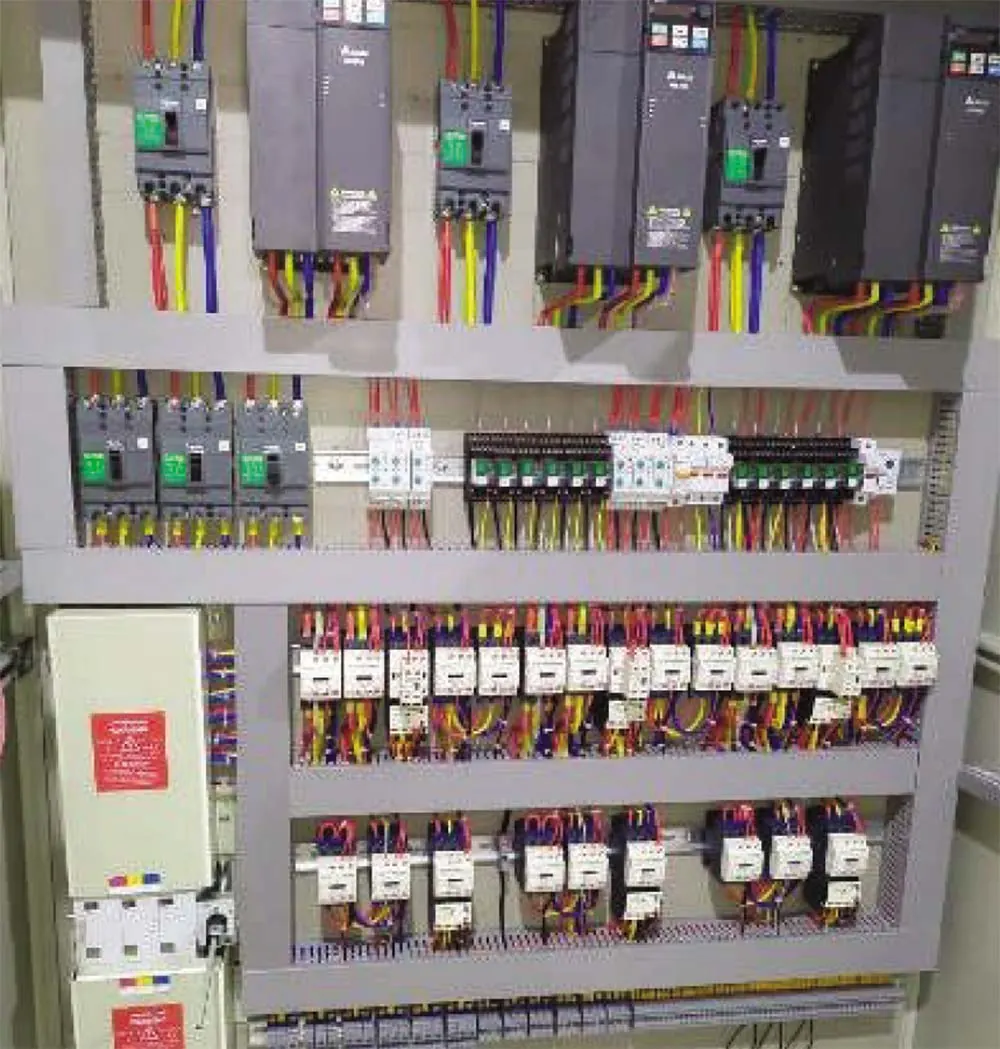
The right motor starter depends on three things: how much starting current the supply can take, how much starting torque the load needs, and whether the motor has to run at variable speed. Direct-on-line (DOL) is simplest, star-delta and soft starters reduce starting current, and a variable frequency drive (VFD) adds speed control. Al Qudrah Switchgear in Sharjah, UAE builds motor control centres and control panels with all four, and this guide compares them the way we do at design stage.
Direct-on-line (DOL)
A DOL starter connects the motor straight to full supply voltage through a contactor and overload relay. It is the cheapest and simplest option, and gives full starting torque, but draws a starting current of roughly six to eight times the motor's full-load current.
DOL suits small motors and any motor where the supply is stiff enough to take the inrush without an unacceptable voltage dip. Utilities and consultants in the UAE often set a limit on the motor size that may be started DOL, and the limit varies by authority and supply arrangement. Above that size, a reduced-current method is needed.
The mechanical side matters too. DOL starting hits the coupling, belts and driven equipment with a sharp torque step, and in pumping systems it can cause water hammer when the pump starts and stops abruptly.
Star-delta
A star-delta starter starts the motor in star, which applies about 58% of line voltage to each winding, then switches to delta for running. Starting current and starting torque both drop to about one third of their DOL values.
It needs a motor with both ends of all three windings brought out (six terminals) and rated for delta connection at the supply voltage. It uses three contactors and a timer, so it is still inexpensive.
The weaknesses are known. Starting torque of one third is too low for loads that start under heavy load, such as loaded conveyors or positive-displacement pumps. The open transition from star to delta causes a short current and torque spike, sometimes as high as a DOL start if the timer switches before the motor is near full speed. Star-delta works well for centrifugal fans and pumps that start lightly loaded, and is still common in older specifications.
Soft starter
A soft starter uses thyristors to ramp the motor voltage up smoothly, limiting starting current to a set value, typically two to four times full-load current depending on the load. Most units then bypass the thyristors with a contactor once the motor is at speed.
Soft starters give a smooth start and stop without the transition spike of star-delta, and pump models offer a controlled stop that reduces water hammer. They work with a standard three-terminal motor. They do not control speed: once started, the motor runs at full speed like a DOL motor.
Because torque falls with the square of voltage, a soft starter cannot give high starting torque at low current. For heavy starting loads it is often not the right tool.
Variable frequency drive (VFD)
A VFD controls both voltage and frequency, so it can start the motor with close to rated torque at about rated current and then run it at any speed. It is the only option of the four that saves energy on variable loads.
On fans and centrifugal pumps, power falls roughly with the cube of speed, so running at reduced speed instead of throttling with a valve or damper saves a large share of the energy. That is why VFDs are standard in AHUs, FAHUs and booster pumps in UAE buildings.
The costs are price, heat and harmonics. A VFD dissipates a few percent of its rating as heat inside the panel, which needs ventilation or cooling in a hot plant room. Standard six-pulse drives draw distorted current, so larger installations need DC chokes, line reactors, or active filters, and any capacitor bank on the same network usually needs detuning. Long motor cables may also need output filters to protect motor insulation.
Comparison at a glance
The table summarises typical behaviour. Exact figures depend on the motor, the load and the device settings.
| Method | Starting current | Starting torque | Speed control | Main drawbacks |
|---|---|---|---|---|
| DOL | About 6 to 8 × FLC | Full | No | Voltage dip, mechanical shock |
| Star-delta | About 1/3 of DOL | About 1/3 of DOL | No | Transition spike, six-terminal motor needed |
| Soft starter | Adjustable, about 2 to 4 × FLC | Reduced (varies with voltage squared) | No | Low torque at low current |
| VFD | About 1 to 1.5 × FLC | Up to rated or above | Yes | Cost, heat, harmonics |
Building the MCC around the starters
Whichever starter you choose, the MCC must coordinate it with its short-circuit protection. IEC 60947-4-1 defines Type 1 and Type 2 coordination; Type 2 means the starter remains fit for use after a short circuit, apart from possible light contact welding, and is the usual requirement in specifications.
Coordination is proven by the device manufacturer's tested combinations of breaker, contactor and overload relay, so a panel builder should select from those tables rather than combining parts by rating alone. Other MCC details we settle at design stage: the form of separation (often Form 3b or 4b so one starter can be worked on while others run), heat load from drives, local and remote control, and interfacing with the PLC or BMS. Our MCCs are built to the same IEC 61439-2 verified designs as our MDBs.
For VFD panels in air handling plant, see FAHU and AHU control panels. Our MCC range is on the MDB, PCC and MCC page.
Frequently asked questions
When is a DOL starter acceptable?
DOL is acceptable when the supply can take the starting current, typically six to eight times full-load current, without a voltage dip that disturbs other equipment, and when the driven machine can take the torque shock. UAE authorities and consultants often limit the motor size that may be started DOL, and the limit varies, so check the project requirement.
Is a soft starter better than star-delta?
For most centrifugal pumps and fans, a soft starter gives a smoother start, no transition current spike and a controlled stop, and works with a standard three-terminal motor. Star-delta is cheaper and has no harmonic or heat issues. Neither controls speed. Choose based on the starting load, the motor terminals available and the specification.
Do VFDs cause problems with capacitor banks?
They can. Six-pulse VFDs produce mainly 5th and 7th harmonic currents, and a standard capacitor bank on the same network can resonate near those frequencies, leading to overheating and early failure. Where drives make up a significant share of the load, the capacitor bank should be detuned, commonly with 7% reactors, after a harmonic assessment.
What is Type 2 coordination in a motor starter?
Type 2 coordination, defined in IEC 60947-4-1, means that after a short circuit the starter causes no danger and remains suitable for further use, although light welding of contactor contacts is allowed if they can be separated easily. It is achieved by using the manufacturer's tested combination of breaker, contactor and overload relay.