
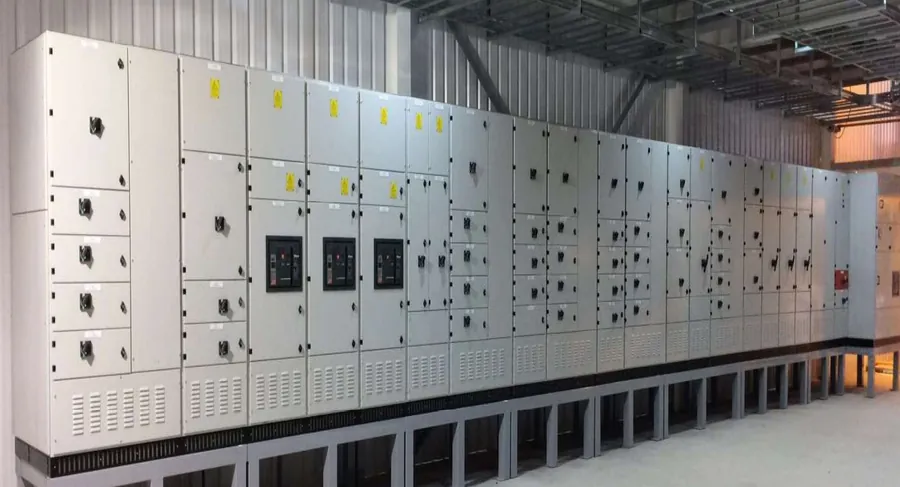
To size a main distribution board you need four numbers: the rated current of the assembly, the short-circuit withstand at its location (Icw and Ipk), the IP rating for the room, and the ambient temperature the board will actually run in. Get any one of them wrong and the board will either trip, overheat or fail to pass review. This is the checklist we use at Al Qudrah Switchgear in Sharjah, UAE when an MDB enquiry arrives.
Start with the rated current of the assembly
The MDB's rated current (InA under IEC 61439) is the current the main busbars can carry continuously without exceeding temperature-rise limits. It is usually set by the transformer or the incoming supply, not by adding up the outgoing breakers.
A 1500 kVA transformer at 415 V has a full-load current of about 2090 A, so its MDB is normally built around a 2500 A incomer and busbar. A 2000 kVA transformer gives about 2780 A and leads to a 3200 A board. The calculation is simple: kVA divided by (√3 × voltage). Keep a margin for future load where the consultant asks for it, but don't oversize the busbar beyond the incomer; it adds cost without adding capacity.
Outgoing circuits are a separate question. IEC 61439-2 uses a rated diversity factor (RDF), because not every feeder runs at full load at the same time. Where the specification doesn't give one, the standard provides default values that fall as the number of outgoing circuits rises: 0.9 for two or three circuits, 0.8 for four or five, 0.7 for six to nine, and 0.6 for ten or more. Ask the consultant early if any feeders will run at full load continuously, such as chillers or process loads, because those may need a factor of 1.
How do you choose the short-circuit rating?
The board's rated short-time withstand current (Icw) must be at least the prospective fault current at the MDB, for the duration the specification states, usually 1 s or 3 s. The rated peak withstand current (Ipk) must also cover the first peak of the fault.
The fault level comes from the consultant's short-circuit study. As a first estimate, divide the transformer full-load current by its impedance voltage. A 2000 kVA transformer with 6% impedance gives roughly 46 kA at the LV terminals with an infinite upstream source, before adding motor contribution. A 1500 kVA unit at 6% gives around 35 kA. Real values are a little lower once cable and upstream impedance are counted, but motors running at the moment of the fault push them back up.
The peak value follows from the RMS value and a factor that depends on the power factor of the fault. For fault currents above 50 kA, IEC 61439 uses a factor of 2.2. That is why our tested rating of 65 kA for 3 s carries a peak of 143 kA. If the study gives 50 kA, a 65 kA board has margin; if it gives 70 kA, it does not, and the answer is a different design or a current-limiting arrangement agreed with the consultant.
Ambient temperature: the UAE problem
IEC 61439 sets its reference conditions at an ambient that does not exceed 40 °C with a 24-hour average no higher than 35 °C. Many UAE electrical rooms run hotter than that in summer, particularly if ventilation is poor or air conditioning fails.
A board verified at 35 °C and installed in a 45 °C room cannot carry its nameplate current without exceeding its temperature limits. There are three ways to handle this: derate the board, use a design verified at a higher ambient, or guarantee room cooling. The specification should say which. Our tested designs were verified at 50 °C ambient, so we can quote a board's rating for the conditions it will actually see instead of applying a rough derating afterwards.
Also check device ratings. ACBs and MCCBs have their own temperature derating tables, and a breaker inside a closed compartment sees a higher local temperature than the room. The manufacturer's data, and calculation tools such as Legrand XL PRO³ that we use for heat dissipation, settle this at design stage.
IP rating and form of separation
Choose the IP rating (defined in IEC 60529) for the room, not for the worst place in the building. An MDB in a clean, ventilated electrical room needs less than one in a plant room exposed to dust, dripping water or wash-down.
Higher IP ratings close up ventilation paths, so they affect temperature rise. That is another reason to state the IP and ambient together. Al Qudrah builds MDBs from IP43 to IP54. The form of separation, which we explain in Forms 1 to 4b explained, is chosen at the same time, because barriers also trap heat.
MDB sizing checklist
Before asking for a quotation, have these values from the single-line diagram and specification:
| Parameter | Where it comes from | Typical example |
|---|---|---|
| Rated current (InA) | Transformer rating or incoming supply | 2500 A for a 1500 kVA transformer |
| Icw and duration | Short-circuit study | 50 kA for 1 s, or 65 kA for 3 s |
| Ipk | Derived from Icw | 143 kA for 65 kA |
| Voltage | Supply authority | 400/415 V, 3 phase, 4 wire, 50 Hz |
| Ambient | Room design and specification | Up to 50 °C |
| IP and form | Specification | IP42 to IP54; Form 3b or 4b |
| Incomers and couplers | Single-line diagram | Two incomers with bus coupler, interlocked |
| Metering and protection | Authority and consultant | Authority meter CTs, LSIG on ACBs |
Metering requirements and the arrangement of the utility's CT chamber vary between DEWA, SEWA, ADDC and Etihad WE. We build to the approved authority drawings for the emirate the project is in.
Our standard MDB range is described on the main distribution boards page, with its verified ratings: up to 3200 A, 65 kA for 3 s, insulation voltage up to 1000 V and impulse withstand up to 12 kV.
Frequently asked questions
How do I calculate the MDB rating from the transformer size?
Divide the transformer kVA by the square root of three times the line voltage. At 415 V, a 1000 kVA transformer gives about 1390 A, a 1500 kVA gives about 2090 A, and a 2000 kVA gives about 2780 A. Select the next standard incomer and busbar rating above that figure, usually 1600 A, 2500 A and 3200 A respectively, and confirm with the consultant.
What is the difference between Icw and Ipk?
Icw is the RMS short-circuit current the board can carry for a stated time, typically 1 s or 3 s, without damage. It tests heating and sustained forces. Ipk is the highest instantaneous current at the first peak of the fault, which produces the largest mechanical force on busbars and supports. Both must be equal to or above the values from the short-circuit study.
Do I need to derate an MDB for UAE temperatures?
If the board's design was verified at the standard reference ambient of 35 °C average and the room will run hotter, yes. The alternative is to use a design verified at the higher temperature. Al Qudrah's tested designs were verified at 50 °C ambient, which removes most of the guesswork for hot electrical rooms.
Should the MDB have a 1 s or 3 s short-circuit rating?
The consultant decides, based on the protection scheme. A 3 s rating gives more time for upstream protection to clear a fault and is common in specifications for main boards, but it needs a stronger design. Whatever the value, make sure the certificate shows the same duration as the specification.