
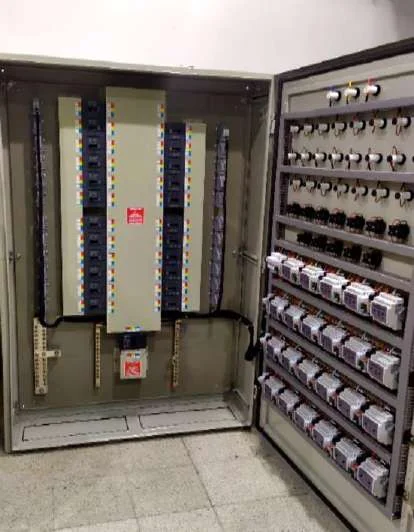
In a UAE building, low-voltage power flows through three levels of board: the main distribution board (MDB) takes the supply from the transformer, sub-main distribution boards (SMDBs) split it by floor, zone or plant room, and final distribution boards (DBs) feed the individual lighting and power circuits. Each level has its own job, ratings and protection devices. Al Qudrah Switchgear builds all three in Sharjah, UAE, and this is how the hierarchy fits together.
The main distribution board (MDB)
The MDB is the first LV board after the transformer. It receives the full supply, carries the utility's metering arrangement, and distributes power to the SMDBs, large plant and motor control centres.
An MDB typically has one or two air circuit breaker (ACB) incomers, often with a bus coupler, and moulded case circuit breaker (MCCB) outgoing feeders. Ratings on UAE projects commonly run from 1600 A to 3200 A, set by the transformer size. Because it sits closest to the transformer, the MDB sees the highest fault level in the building, so its short-circuit rating is the most demanding. Our MDBs are built on designs verified to IEC 61439-2 at up to 3200 A and 65 kA for 3 s.
Larger industrial sites call the same board a power control centre (PCC). Where it mainly feeds motors, it becomes a motor control centre (MCC). We cover sizing in detail in How to size an MDB.
The sub-main distribution board (SMDB)
An SMDB sits where a large feeder cable from the MDB ends and several smaller circuits begin. It feeds the final DBs on a floor, a zone or a group of plant equipment.
SMDBs usually have an MCCB or switch-disconnector incomer and MCCB outgoing ways. Ratings are smaller than the MDB, often a few hundred amps, but the fault level can still be high if the SMDB is close to the transformer room, which is common in plant rooms and basements. That is easy to overlook. An SMDB fed by a short cable from a 2500 A MDB may see a fault current not much below the MDB's own.
In a residential tower, a typical arrangement is one SMDB per group of floors or per riser, feeding the apartment DBs. In a villa community, a single villa may have one SMDB or none, depending on load and how the consultant draws the scheme.
The final distribution board (DB)
The final DB divides its feed into individual lighting, socket and small power circuits, each protected by a miniature circuit breaker (MCB) or a residual-current breaker with overcurrent protection (RCBO).
DBs are single or three phase and usually rated up to a few hundred amps at most. Earth-leakage protection matters most here, because these circuits feed equipment that people touch every day. Circuit labelling matters too. A DB that is labelled to match the as-built drawings saves the facility team hours every time a circuit trips.
Typical ratings at each level
The exact values depend on the building, but the pattern below is common on UAE projects.
| Board | Fed from | Incomer | Outgoing devices | Typical rating |
|---|---|---|---|---|
| MDB / PCC | Transformer | ACB, often two with a bus coupler | MCCBs, sometimes ACBs | 1600 A to 3200 A |
| SMDB | MDB | MCCB or switch-disconnector | MCCBs, MCBs | 100 A to 800 A |
| Final DB | SMDB or MDB | Isolator or MCCB | MCBs, RCBOs | Up to about 250 A |
| Emergency boards (ESMDB, EDB) | Generator / ATS | As specified | As specified | Depends on life-safety load |
Emergency boards follow the same hierarchy but are fed through an automatic transfer switch from a standby generator. They supply fire pumps, smoke extract, emergency lighting and other life-safety loads, and are usually kept physically separate from normal boards. See ATS panels for mains and generator changeover for how that transfer works.
How do the levels work together?
The levels are coordinated so that a fault is cleared by the device nearest to it and nothing upstream trips. This is called selectivity or discrimination, and it is the reason the hierarchy exists.
If a short circuit happens on a socket circuit, the MCB in the final DB should trip, while the SMDB incomer and the MDB feeder stay closed. Achieving that needs breakers chosen together: current settings, time delays and, at high fault levels, manufacturer selectivity tables. Using breakers from one manufacturer's range throughout makes this easier, because their selectivity tables are tested together.
Cascading (back-up protection) is the related idea of letting an upstream breaker help a downstream one with a lower breaking capacity. It saves money but can reduce selectivity, so the consultant has to decide where it is acceptable.
Voltage drop is the other thread that ties the levels together. Each cable from MDB to SMDB to DB adds drop, and the total at the final circuit must stay inside the limits set by the consultant and the local authority. Long risers in tall towers often lead designers to add SMDBs closer to the load.
What changes between the authorities?
The hierarchy is the same across the UAE, but details such as metering, earthing arrangement, labelling and approval drawings vary between DEWA, SEWA, ADDC and Etihad WE. The consultant and the authority decide which rules apply.
For example, the arrangement of the utility meter and CT compartment in the MDB is set by the authority, and each one has its own drawings and inspection steps. In Sharjah, Al Qudrah is a SEWA Certified Company, Grade 1, for switchgear assembly up to 3200 A. We build to the approved drawings for the emirate where the board will be installed.
The full range of boards we build is on the SMDB and distribution boards page.
Frequently asked questions
What is the difference between an MDB and an SMDB?
The MDB is the main board fed directly from the transformer. It carries the full building load, the highest fault level and usually the utility metering, with ACB incomers. An SMDB is fed from the MDB and distributes power to a floor, zone or plant area, usually with an MCCB incomer and smaller ratings. Both are built and verified to IEC 61439-2.
Do small buildings need an SMDB?
Not always. A small building or a single villa may feed final DBs directly from the main board. SMDBs become useful when loads are spread over several floors or zones, when cable runs are long, or when the designer wants better selectivity and simpler maintenance. The consultant decides this on the single-line diagram.
Why is selectivity important in the distribution hierarchy?
Selectivity means only the protective device closest to a fault trips. Without it, a fault on one socket circuit could trip an SMDB or even the MDB feeder and black out a floor or a whole building. Selectivity is achieved by choosing breaker ratings, settings and makes together, using the manufacturer's selectivity tables.
Are emergency boards part of the same hierarchy?
They follow the same MDB to SMDB to DB structure but are fed through an automatic transfer switch from a standby generator. They supply life-safety loads such as fire pumps and emergency lighting, and specifications usually keep them physically separate from normal boards so a fault on one system cannot take out the other.